Showing posts with label academia. Show all posts

Friday, May 11, 2012

Reflections on the First Year of the Tenure Track


It’s been one hell of a year at East Tennessee State University. Lots of highs. Some interesting lows. Overall, though I have to say, I’m pretty pleased with myself. Not pleased – in that cocky “I can do no wrong, don’t I kick ass” sort of way. Pleased with the fact that I made it through the first year. Why would I say that? I’ll tell you.

I say that because in my years in academe, I’ve seen any number of people fall off the tenure track. Some brilliant, hard-working people in fact. That’s one of the dilemmas I have regarding my dissertation. I was thinking about doing a longitudinal piece and re-interviewing those people who would be now getting tenure. Trouble is – out of my small sample – half of them didn’t make tenure. A couple of them are not in academe anymore at all. So surviving the tenure-track isn’t as easy as, say, baking a cake. Not sure why I used that analogy, because I can’t bake for crap…but whatever.

I have to say straight out that there’s no way I would have survived this first year without my comrades in Communication Studies at East Tennessee State. So a shout out to Drs. B., D, O, & K.  First off, they took a chance by hiring someone who at the time was not in academe at all, but only tangentially – going to conferences, applying for jobs – trying to get back into academe while not employed. Hiring in academe is a risky business anyway, and they certainly took a risk. Second, as collegues, they made me feel welcome. 

They let me ask my “stupid” questions and answered them, without rolling their eyes at the silliness of "The Noob." While I know at times I got on their nerves with all the questions, interruptions the - “Hey what’s with the….?” –questions, they were all gracious. I cannot emphasize how important they were to my making the most out of this first year. 

On the home front, I arrived here in Johnson City, TN with nothing, and it took me a while to get set up. For the first month, I didn’t even have a bed. When that first paycheck rolled in, I spent all of it on furniture. The following month all my money went to pay off past due bills. Nice to be getting on track that way after a year of living on unemployment. Acclimating to JC wasn’t as difficult as I thought it would be, given that I’d lived in Tennessee once before, down in “The Noog.” I’ve made some friends. Found some like-minded compatriots to shoot the breeze with. I haven’t done much exploring. That will come this summer.

Not everything went as smoothly as I would have liked though. In my own opinion – and later confirmed by the student evals – my Organizational Communication class in the fall was a mess. Some of that had to do with learning the students: their expectations, their readiness, their culture. Some of that had to do with teaching a class that I hadn’t taught since 2007. So I learned some things as I went along: give four tests instead of three, drop a project that didn’t work as planned, rearrange the classroom to make it more interactive, don’t assume that everyone has (or even wants) a Twitter account, kill the two extra texts. 

What I learned from the disaster of my Org class, I incorporated into my Group Communication class. That class, I feel – though I don’t yet have the student evals to check my thoughts – went a whole lot smoother. I’m looing forward to teaching Org Com again this fall, incorporating everything I learned from the first go-round. It should be much improved. Adjust, readjust, and readjust more. 

As Dr. D explained way back last year when I was on my interview, while the university will talk a great deal about service and will talk a great deal about teaching, they will not stress publishing. “But don’t let that fool you.”  So I took that to heart immediately. So in my first year I’ve published three pieces, which I think is good, but not great. I also have two things that are in press that will come out sometime next fall. Although I post a lot of my successes on Facebook, I have an overwhelming number of rejection letters as well!!! That’s the game though, right? Just keep plugging away on the writing and the submitting. My goal is to have three per year. So far I’m on track and happy about it. If you are interested, you can find my pieces here, here, and here.

One of the things I’ve learned is not to ask “Why?” so much. Why? (Yes, irony.) Because – and I should have realized this – it’s beause when you ask, you also assume responsibility. So when I asked “Why don’t we have an Honors-in-Discipline Program in Communication Studies?” the resounding answer was “Because you haven’t started it yet.” So I did! It took a year to get the program proposed, set-up, and initiated. So in autumn, we’ll have our first honors students. I’m pretty stoked about that. Shout outs to both Dr. Harker and Professor C - both from our Theatre and Dance Division - for helping me with all the intricacies of getting the program situated and walking me though all the necessary steps. (See what I mean about good colleagues!?) Adjust, readjust, and readjust more.


There are some frustrating things as well. I’ll spare you all the details, but just list some. A committee that didn’t get its job done. Students that "checked out" mid-semester. The strange way the hiring process went for our lecturer positions. The meetings as we attempt to reinvigorate our M.A. program. Oh. And the never-ending stack of paperwork. Nothing major, just frustrating. A LOT less frustrating than working in information technology, that’s for sure!!!


Despite those frustrations, there were many things that gratified my soul. Our undergrads presenting at the Boland Research Symposium. Presenting at the Spring Mixer with Andrew, aka Classic Andrew, aka Dr. Dunn. Representing ETSU and the Communication Department at NCA and CSCA, while seeing great mentors, peers, friends, bar buddies, former academic outcasts, more friends (that's you Herbig), and #commnerds (all wrapped in one, usually).

Finding out that certain colleagues - the previously mentioned Dr. Dunn and the yet as unmentioned Dr. M. - and I can collaborate on a very cool internet–based research project. Having interesting, intelligent conversations with graduate students. Watching my undergraduates present at local non-profits. The ability to proffer up two new classes: “Technology, Communication, and Culture” and “Communication and Leadership.”

And so, rather than some “dark night of the soul” as some of the participants from my dissertation research experienced, I find myself thriving, I find myself engaged, I find myself mostly in awe that a kid – who almost never made it out of RCNJ in the first place – is in the position of having finished up his first year on the tenure track. And I couldn’t have done it without the great colleagues that I do. So with all that is in my soul, I thank you my colleagues. Here's to a great year two!

Go Bucs!


Wednesday, April 18, 2012

Write your story. It is important.

To all you qualitative researchers out there: keep writing.

I don't generally get personal on this blog, but I've been overwhelmed lately by the good people in academe. Here at the end of my first year on the tenure-track seems a good time to say thank you.

Many of you know my story about trying to find a full-time tenure-track academic position, which started in 2007 when I was ABD and ended in 2011 when I got hired at ETSU. I offer my thanks, my gratitude, my heartfelt love for those of you you sent me good karma, happy vibes and thoughts, as well as prayers.

What I was most astounded by, however, wasn't the support from people that know me. No. Once I published the piece about my experience "I Know I'm Unlovable": Desperation, Dislocation, Despair, and Discourse on the Academic Job Hunt" in Qualitative Inquiry (an excellent journal in its own right) I was overwhelmed by the response.

Hundreds of people contacted me about it. Hundreds! I had no idea that was going to happen. After all, it's "merely" a personal narrative piece.

Total strangers started emailing me about how the piece spoke to them. People started Tweeting me about it to say "Thanks - this needed to be written." They tweeted about it to other people...and they too Tweeted me. People started FaceBook messaging me about how they are going to have all their graduate students read it. People told me it spoke to them, that I was brave to tell one of the stories that is often silenced and whispered in academia, but rarely spoken about out loud.

Brave? It wasn't brave. While I won't say that writing that piece saved my life, it did help preserve my sanity. For those of you who doubt my sanity, well, I guess it preserved my functional insanity. Brave? No. Necessary? Yes.

The point is that I was overcome by the response to the piece. So many people reached out to say how it touched them. A few said they cried when they read it, because it matched their own experience. For some it was the confusion and the anger that resonated with them. For some it provided a catharsis - by simply knowing there are other people out here suffering through the same things they are.

Here's the lesson, if a lesson can be taken from this. To all you qualitative researchers out there: keep writing. Keep on writing. See, your stories are important.  You don't know how important your stories are unless you tell them. You don't know what an impact your story can have on someone, unless you actually write it. You don't know how big your personal community is - or your particular experience is - unless you write about it. Write your story. It is important.

I had no idea that my little piece would create the stir it did. I'm glad it did.

So I just wanted to say thank you.

Andrew

Thursday, March 8, 2012

Counter-Narrative: An Important, Much Needed Book


Bud Goodall starts out with this truth: 

We on the left suck at narratives. 

We do – at least compared to the right - be that right the economic libertarians, the religious conservatives, the neo-cons, or the conspiracy theorists like the Birthers.  Slowly but surely those on the right have spun their tales so well, that what they say is too often taken for granted, as given, as the way things are and the way things ought to be. All these ‘givens’ aren’t givens at all. They are stories told over and over and over until we believe them to be true. For instance:

“Free markets should be unfettered!” (Hello financial crisis.)
“Democrats are weak on defense!” (Goodbye Osama Bin Laden!)
“Jesus was not interested in justice!” (Hello? Have you read the New Testament?)
“Obama is a Kenyan born Muslim!” (Hello long-form birth certificate!)
“Rush Limbaugh is a Big Fat Idiot!” (Yes, ridicule is helpful but not constructive in the long term.)

Sure, we have facts on our side.
Yes, the deficit was caused by the Bush tax cuts and the wars.
Yes, Jesus was interested in justice.
Yes, the founding fathers were human with human foibles.
Yes, Teabaggers gave themselves that name without knowing what “Teabagging” is.

Here’s the thing: facts only matter if they are embedded in a good story. To quote Reagan’s 1988 slip up: “Facts are stupid things.” Narratives drive information, not the other way around.

Have you ever wondered how Al Queda can recruit people into killing themselves? Have you ever wondered why Glenn Beck’s conspiracies were accepted by so many? Have you ever wondered why the Birther issue will not die? Have you ever wondered why people who say they follow Jesus only follow the free-market Jesus? Have you ever wondered why academics are losing the battle over who academics are and what we do? Have you ever wondered what ever happened to the concept of the common good (clean air and water, state and national forests, public education, etc.)? Here you will find the stories conservatives tell dismantled, examined, and critiqued.

Finally Goodall doesn’t let us off the hook. He delivers to us an ultimatum.  If we don’t start actively writing our narratives to counter the conservative narratives, we will no longer have the words by which to tell our narrative.

Read it. Practice it.

Wednesday, February 22, 2012

"Hey Andrew, How Do You Get So Much Writing Done?"

People ask me this and I tell them I write a lot. People sometimes say, "You're really smart. That's how you get so much accomplished." "Well hold your horses," I tell them. "I'm not really THAT smart. I just work hard and I write everyday." And that's the first key. So if you really want to know how I get so much published in journals - though it's probably similar if you are writing books, magazine articles, or for a newspaper - here is what I do. None of this is original. They are ideas I've snagged from other authors, colleagues, peers, friends, mentors. 


1. Always, always write. Whether you are sitting down with a vague idea (Chaos theory and academic conferencing). Write. Or have just a bare sketch (Buffy, Spike, and Foucault). Write. Or are entertaining two opposing thoughts (Abbot and Costello Meet Punk Rock). Write. Or have come up with simply a weird title (like “Kierkegaard and Human Resources in the Modern Corporation,” for example) write. Write a little each day, write a lot each day. Write. Take Anne Lamott’s advice and write that “shitty rough draft.” No one will see it but you, so don’t worry about grammar, punctuation, references, footnotes, or any of that mundane stuff. That’s not writing. That’s editing. That comes later. Just write. Get words on the page. Sometimes they come slowly – word by word. Sometimes they come in a flourish. No matter. Write.


2. Take a break. Seriously. The pressure to publish is insane in academe. So write. Write until your P.O.S. draft is done.  Then stop. Push yourself away from your desk. Close the laptop. Whatever. Just stop. Go outside. Take the Underwater Basket Weaving class that meets every Saturday. Just don’t write. Have a beer at a local water hole. Shoot a game of pool someplace. Smoke crack. Walk the dog. Buy ferrets. Paint your abode. Work on your syllabus. Read some fiction. Go see a kickin' flick. Work on a flier for your upcoming summer class. Don’t write. For three days. Don’t write. This will refresh your mind.


3. Edit. As Bud Goodall once said, “All good writing is re-writing.” This does not mean merely editing. This means giving your work a careful read. By doing so you find concepts that are unclear and need to be expanded. Hack away the passive voice. Keep to your thesis statement. This means re-examining thoughts and ideas that may be tangential to your main argument and dumping them – perhaps they are the germ of a different piece. Like Red Leader said in Star Wars, “Stay on target.” This writing can be the real muck, but don’t be deterred. Revise, refine, rewrite. Put it away again. Just leave it be. 


4. Edit again. Here’s where things get tough. We generally like all the words we write. As the Police song goes, “I'm a walking nightmare, an arsenal of doom” and be a Demolition Wo/Man. Here’s where you kill your children. Some of them are still-births and need to be eliminated. Some of them sound grand and promote a flourish you think is delightful. Kill them. Axe them. Erase them. Murder them. While you want to maintain your voice, anything that is unneeded needs to go. Be a brutal dictator.


5. Show it to peers. For academics this is the hardest part, because we don’t like anyone to think we are stupid. There’s a lot of work and pride that goes into writing. Let me give you a hint. Nothing you write is perfect. Ever. So let it “leave your hand” and go into a colleagues'. This is absolutely important. I wrote a piece for an ethnography class I had as an M.A. student at Saint Louis University. I wrote it and rewrote it and rewrote it. I sent it out for publication over and over. Well, finally I let some other people read the thing. Turns out I was trying to do too much in that one piece. Bob Krizek read it when it was a class draft. My friend Sam read it. Eric Eisenberg read it. They all gave me great advice. I still could not get it published. Finally, I took it to the Young Scholars class at CSCA. This group of scholars said, “Andrew, its almost like you have two pieces here. One on the process of organizing at a new nonprofit, and one on your own personal narrative as a punk rocker returning to the scene after a dozen years.” They were correct. I broke it into two pieces. One piece is out. The other is in press. If I had never shown it to anyone, I’d never recognized the problem.


6. Edit. Again. Word by word. Punctuation mark by punctuation mark. Line by line. Reference by reference. Work out those transitional sentences that connect paragraph to paragraph. (Confession: I hate those sentences. I stink at them. For me they are the most arduous task. Still they must be done.) Essential tedium.


7. Send it out. Pick a journal that matches what your subject is and what your method is. I’m a qualitative researcher, so as much as I’d like to get something published in Communication Monographs, that’s not going to happen. There’s no goodness of fit. Don’t mess with journals that don’t do what you do. I don’t want to waste my time and the editor’s time either. Search out journals. As a qualitative organizational communication scholar, I had to find my outlets. Like what? Qualitative Research in Organizations and Management: An International Journal. Journal of Loss & Trauma. Qualitative Inquiry. Journal of Computer-Mediated Communication. Studies in Symbolic Interaction. Journal of Organizational Ethnography. International Review of Qualitative Research. Qualitative Communication Research. If it gets rejected outright – send it to the next journal on your list. Don’t waste time feeling sorry for yourself. When you get a revise and resubmit, revise and resubmit. Period.


8. Keep writing. I generally have two or three things always in progress. When something is accepted for publication, I begin a new piece, even if that possible piece is some hackneyed idea like “Adding bleach to the laundry as a speech act.” Brainstorm. Read good fiction ( I prefer Horror and Hard-Boiled Detectives) and nonfiction. Write. Keep writing. Always write. Every day. Every day. That’s the only way to progress.


Bonus step: Unplug. Kill your cable. There's nothing on there anyway. Hulu or Netflix what you really want to watch. Seriously. You'll never realize how much time you have to write until you realize how much time you have to write.

Saturday, February 18, 2012

My New Course: Technology, Communication, and Culture


A new class that I've prepped for the summer. It is the first new class I've proposed and with the help of my chair, Dr. Amber Kinser (who I cannot thank enough for making sure this new faculty member knows what he's doing) this has been a pretty darn smooth process.

Now the only question will be if it 'makes.' If it makes, that would be the first step into getting into the Communication Department rotation. Here's hoping!

Sunday, January 29, 2012

An Open Letter to President Obama from Someone "On Notice"

Dear Mr. President,

In your last State of the Union you put public higher education “on notice,” if we do not to try to keep costs down. I’ve been in academe for over 10 years both in information technology and more recently as faculty. Let me give you a little advice. Universities are raising tuition for two basic reasons: cuts in public funding and cuts in student aid. Not loans. Aid.

Universities now receive less funding from state government and more financial patronage from industry. Over the last thirty years, states have cut their budgets for postsecondary education by a national average of 34 percent. At the same time, vocational training in universities increased due to pressure from both students – who want to graduate and attain employment – and industries that need students to have certain skills. Institutions of higher education began engaging in market-like behaviors, a kind of “academic capitalism” in which educational outcomes (students and artifacts of research) are “products.” In the past twenty years, university autonomy has shrunk under the pressure of government, industry and student demands for accountability. Academia is becoming managed. We are doing more with less. This has led to some interesting consequences.

For example, as of 2003 only 44.9 percent of all faculty members hold full-time tenured positions. Schuster & Finkelstein conclude “contingent or term appointments became during the past decade the modal form of new full-time faculty appointments” (p. 55). In addition, from 1993 to the present, the percentage of all newly hired full-time faculty appointed to non-tenure track positions increased every year from barely more than 50 percent to almost three in five. Looking through a wider lens, in the last thirty years the categories of full- and part-time non-tenure-track faculty—both increased by over 200 percent. Just as in other areas of the economy, more and more faculty members are “outsourcers.” Outsourcers are contingent, non-traditional, term contracted employees, who are solely responsible for their career development and receive little, if any, organizational support, benefits, or recognition.

So in reality Mr. President we have been cutting back for years by hiring part-timers over tenure track faculty members. Guess what? It still doesn’t make up for all the cuts in government funding. It’s time to stop treating a higher education as a commodity and like a public good again.

Mr. President, your threat to put us “on notice” is redundant. We’ve been on notice for twenty years.

Sincerely,

Dr. Andrew F. Herrmann

Saturday, January 14, 2012

On Teaching Group Communication Well, Pt 2

Serendipity? Coincidence? A link into the divine? Whatever the case, I’ll take it. 

In my last post I began talking about my Group Communication class. I included some of the dilemmas all teachers face when dealing with group work and engaging students in both theory and practice. Well, then a friend and mentor of mine – Bud Goodall – posted something on Facebook. 

It is a New York Times article called “The Rise of the New Groupthink” that plainly states,

Research strongly suggests that people are more creative when they enjoy privacy and freedom from interruption.”

I agree with some of the assessment – that group work for group work’s sake is a pointless exercise. Anyone who has been sitting in a meeting to ‘brainstorm’ some totally nonsensical idea knows what I mean. (Especially if the boss isn’t going to take those ideas seriously anyway – but that’s another story of faux participation and paradoxes in organizations.)

However, the point of my Group Communication class is to bring communication theory to life and allow students to learn experientially. The author of the Times’ piece writes:

"But it’s one thing to associate with a group in which each member works autonomously on his piece of the puzzle."

And this is my thought process when I teach group communication. Sure students work in groups, but each person must come to the group with something of value to put on the table. Nor are the class group projects 'useless,' but vary in degrees of length, from the short to the large, and in complexity. Which brings me to what this post was supposed to be about: The assignments from my Group Communication class.

The first is an individual project: Strengthsfinder Paper: A one page paper that explains your strength based on the Strengthsfinder assessment, including a self-reflection on where you have seen this particular strength active in your own life.

Rationale: Most students haven’t spent a lot of time with Socrates’ dictum “Know thyself.” What can they bring to the table? What do they need to know about themselves and the way they relate to other people? This is an exploration of their talent. It’s what they bring to the table.

“Quad-Group” Discussion (QGD): Each initial smaller group of approximately 4 people (hence the term “Quad”) will lead a discussion (for about 30 minutes) on some section of the Rothwell text, between Chapters 4 through 5 to be negotiated in class with other groups and me. Please note that this is NOT a presentation, but a discussion. It consists of four parts:
One week prior to your presentation you must find and send a related academic article to everyone in the class.
Lead a discussion for 25 minutes on your topic.
A one-page handout for your classmates.
An activity to go along with your discussion.

Rationale: A short project to start. Something within the safe confine of the classroom experience. Think of this as the ‘getting to know each other’ part of this group experience. This is not a presentation (no PowerPoints) but a discussion of the topic they have negotiated with the other groups and myself.

"The Edge” Assignment: Each “Quad Group” will set up a time with ETSU’s “The Edge” radio station and lend their voices for a drop, a legal, a promo, a sting, or an ad.

Rationale: Stepping out into the world, even if it still the ETSU world. The groups have to make the contacts, set up the appointments with the General Manager, and then go into the studio and create what the GM determines needs to be made. This gives them practical experience in those areas, as well as lending their voices to the Broadcast Division of the Communication Department.


Dinner and the FSNP Paper: Two “Quad-Groups” will combine to become a “Double-Quad.” This larger group will have to plan a meal from scratch, eat that meal together, and produce one co-written paper. I will be looking for evidence of your group's development and its accomplishments, and of the various contributions to the dinner and the writing process. This five-page co-constructed paper is your group response to how your “Double-Quad” worked together, concentrating on the forming, storming, norming, and performing (FSNP) aspects of group development. You will present to the class you dinner menu, and a brief discussion of the group project. 

Rationale: Leaders and other roles are generally in place within the “Quads” by the time this project rolls around. This stirs things up. Power struggles often raise their heads as groups come together. Negotiating is more difficult and the number of persons in the group makes every thing more chaotic and complex. HOWEVER, the actual project of making dinner together provides students with a pretty relaxing, fun, enjoyable atmosphere – plus they get to eat well.

The “Double-Quad” Volunteer Project & Paper: Each “Double-Quad” will volunteer with a nonprofit organization in the greater Johnson City area to complete a project of some significance both to the agency you're working for and to yourselves and your group. Group members must work together on location for at least 7 hours during the semester--some might involve much more than this, depending on how much off-site preparation is required. The objective here is, as best you can, to do something for an organization that involves your group as a group and that utilizes your group's unique abilities. Documentation is essential. The grade for this project consists of two components on which you will be graded: A professional presentation to the organization for which you volunteered, which I also attend. A co-constructed paper of 12 pages (not including references) on how the team worked while doing your volunteer project, what theoretical concepts you found informative as you worked through the process of becoming a group, the accomplishment of the necessary tasks, as well as the struggles and dilemmas you encountered.

Rationale: The big Kahuna!: serving the Johnson City community. Getting students involved with individuals they don’t necessarily run into in their daily lives. For example when I did this at USF, one group worked at the Moffett Cancer Center. At Mizzou one group worked with a home for abused children. Another for a literacy program. Another for the local animal shelter. Another for undernourished kids. A LOT of planning and collaborating and negotiating goes into, not only the project, but the co-written paper. Students found these projects not only useful, but self-fulfilling.


So that’s it. Taking theory and making it practical. Going from small groups and small projects to larger groups and larger projects. While Organizational communication is my passion, this is –by far – my favorite class to teach.


On Teaching Group Communication Well

Anyone who’s spent any time teaching eventually runs into the dilemma of making theory come alive for students. That’s why I love teaching Group Communication. It is one of my most successful courses. Students come away with a real understanding of how theory works in practice.  How? I give students the requisite liberty to form autonomous groups – and then send them out into the world. As my syllabus states:

"A significant portion of the class time will be allotted to allowing you to meet with your fellow students in your groups. We will form groups by choosing class members - and being chosen - through a process to be described later in the semester. Groups will be challenged with a goal for the semester, as well as two ongoing tasks, and also will be provided activities every week that are related to the course content and designed to further both the development of your group and your ability to link the conceptual and experiential modes of learning. But most of what goes on in the group is up to you - and to your fellow group members. The groups will meet during class every week throughout the semester, and no doubt, will meet outside of class as well. The challenge is how to make the most of this unusual opportunity.”


This makes today's student nervous. Students have been trained in the banking system version of education, where the teacher deposits information into the student’s brain and then the student withdraws that information and puts it on a test. I feed you. You vomit it up. That training is not useful in this kind of class. I give my students forewarning on this aspect of what the class is going to be like:


“Some of you may find this form of active "learning-by-doing" a disturbing experience. I can't tell you "what to accomplish" or "what we should be doing in the group." It isn't that I won't. I can't. You have to work it out, individually and together. Learning about groups comes from struggling with the process of trying to become a group. For some, working together and learning to manage those differences will be one of the most rewarding educational tasks you'll ever face. For them, the opportunity to examine one's own needs for authority and the chance to learn openly about communication and human relationships in such a relatively unstructured and safe situation is a welcome one, even though some frustration necessarily will part of this process, too.”

Similarly, in contrast to the banking system of education, I don’t lecture in this class. No lectures. No PowerPoint presentations. No monologues. Rather I frame debates or situations and then let students do in-class team projects and lead discussions about how a particular theory fits within their everyday lives. Given that this is a relatively new way of ‘doing class’ for many students I put an important warning in my syllabus as well:

“Warning!! Please note that this is not a lecture class in any sense of the word, as lecturing in front of the room is the anti-thesis of what this class designed to do. Class time is going to be used for various group-building activities. Therefore, you must keep up with the readings on your own. Please, do not remain in this course unless you are willing to commit yourself to the challenge of learning about communicative processes in groups and about your own communication in groups through the active and student-directed process described above. This warning includes anyone participating on a team sport or who has a job. If you are dedicated to this class, you must be here. If you are dedicated to your athletic endeavors or your employment more than to this class, please be considerate and drop this class. If you remain in this class you are promising yourself to your group, your classmates, and me. Be aware that as a last resort groups can fire a member for nonparticipation – and if you are that member, you will fail the class, because you cannot do an individual project to make up for a group project.”

In my next post, I’ll provide some of the assignments students do during the semester. In in the meantime, here are links to the three texts I use in the class.

Strengthsfinder 2.0


Stay tuned...

Sunday, October 2, 2011

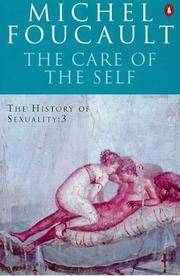
10 Philosophy Books 4 Your Perusal (Pt 8): The Care of the Self


Michelle Foucault


The History of Sexuality, Vol. 3: The Care of the Self 

Ethics. Identity. Selfhood. Self-Discipline. Discourse. That’s how you could sum up the latter part of Foucault’s project, if of course you could sum up Foucault's opus. However, like any good philosopher's works, you just can't sum it up. It is always being put to new and different uses. (Which reminds me of the old quote: "The history of philosophy is just one long footnote to Plato.")

Plus, reading Foucault can sometimes make your head do this.

Anyway, once interested in the genealogy of society, madness, and order, Foucault moved on to the development of the subject, a.k.a. the person, a.k.a. the human individual. It is in The History of Sexuality, Vol. 3: The Care of the Self that Foucault seriously delves into how discourses make us and how we use discourses to make our “selves.” 

Foucault contended that technologies of the self must be comprehended as inextricably connected to his notion of governmentality: the guiding rationales individuals and social structures use to regulate and police norms of thought and behavior. Foucault endeavored to show how the modern sovereign state and the modern autonomous individual co-determine each other’s emergence.

While Foucault was particularly interested in sexuality and the discourses surrounding sexuality and sexual identity his work has been influential in psychology, theology, gender studies, organizational communication. We will talk about some of those later. First, however, some of Michel.

“As a context, we must understand that there are four major types of these "technologies," each a matrix of practical reason: (1) technologies of production, which permit us to produce, transform, or manipulate things; (2) technologies of sign systems, which permit us to use signs, meanings, symbols, or signification; (3) technologies of power, which determine the conduct of individuals and submit them to certain ends or domination, an objectivizing of the subject; (4) technologies of the self, which permit individuals to effect by their own means or with the help of others a certain number of operations on their own bodies and souls, thoughts, conduct, and way of being, so as to transform I themselves in order to attain a certain state of happiness, purity, wisdom, perfection, or immortality.” (1988)

Foucault’s opus indicates the importance of, and interrelationships between, identity, power and knowledge. For Foucault power does not reside is a particular person or institution, but is engendered instead in discourses, practices, and procedures of everyday life and becomes apparent when it is exercised. Power is everywhere in social relations, and is exercised at all levels of an organization and society through various discourses and processes. Human beings are made subjects – or socially constructed – through various disciplinary discourses. The control of the self is a form of control through the discourses of power/knowledge.

As Foucault (1993) noted, in order to study power and the individual one must examine governmentality, the contact points of the “techniques of domination and techniques of the self” (p. 203). Governing people…is not a way to force people to do what the governor wants; it is always a versatile equilibrium, with complementarity and conflicts between techniques which assure coercion and processes through which the self is constructed or modified by himself (p. 203-204). Discipline therefore is not simply imposed from the outside, nor is it always complete, otherwise there would be no place for reflexivity. For Foucault, governmentality is not negative, but productive. It socially constructs subjects, reality, objects and rituals of truth.

While subjects are constructed through discursive processes, they are never powerless, but are active participants in creating the identities they desire by relying on various discourses. They can rebel and resist. (Remember Camus?) Individuals have the ability through these technologies of the self to reflect upon, shape, govern, and be responsible for their selves within these discourses and resources of power, to transfigure themselves to achieve a condition “of happiness, purity, wisdom, perfection, or immortality."

I am an organizational communication scholar and I've been heartily influenced by Foucault. Given the dynamic complexity of interrelated power relations, organizational scholars turned to the concept of struggle, an ongoing, interactive, unpredictable, definition-creating activity that moves beyond the static power/resistance model of domination. Similarly, because power resides in networks of relationships, subjects freely call upon differing discourses in order to enact strategic games, and therefore, play games of identity. In organizations these issues of identity transcend personal, organizational and occupational lines. 

Here are some of my favorite Foucault works and those who have made use of Foucault: 


Michel Foucault's "History of Madness" in English, is the complete version of the English translation called "Madness and Civilization", which since it was abridged, produced some serious misinterpretations. Foucault shows how the idea of "madness" from the Middle Ages through the Renaissance and the Enlightenment to the present, has undergone several transformations of meaning.  It is excellent...

....and it might make your head do this.