Showing posts with label discourse. Show all posts

Thursday, December 22, 2011

What Soren Kierkegard Might Think of Americans


In his book Two Ages, which is superficially a review of a Thomasine Gyllembourg novel with the same name, Kierkegaard examines the political and social dissimilarities between the Romantic period and the modern period. 

‘The present age is essentially reasoning, reflective, passionless, fickly flaring up in enthusiasm and shrewdly resting in indolence’’ (Kierkegaard, 1846/1978, p. 64).

In particular, Kierkegaard critiques such communicative activities as chatter, everyday talk, the press, and the commodification of discourse. Each of these activities is involved in the process Kierkegaard calls leveling. Kierkegaard presents an understanding of how communication activities can create—and individuals can put on—a culturally accepted, but objective, socially constructed definition of self. According to Kierkegaard, this process of leveling leads to objectivity and personal irresponsibility.

Leveling takes individuals out of themselves and makes them part of the public, which for Kierkegaard is an abstraction. Through the continual comparison of selves to others, we create and develop secondhand needs, desires, and definitions of selfhood—of who and what we are to be (Kierkegaard, 1847/1993). 

‘‘The trend today is in the direction of mathematical equality, so that in all classes about so-and-so many uniformly make one individual’’ (Kierkegaard, 1846/1978, p. 85). 

Kierkegaard is charging that unreflective communicative processes create a homogeneous abstraction—the public—where all socialized persons become interchangeable and where no one lives as an individual. Thus, one becomes a mere representation of a type, or a follower of an ideology, a part of the crowd.

Through leveling, the individual accepts society’s monological definitions of one’s self. Kierkegaard claims that rather than enabling people to take personal responsibility for their lives, the modern way of life makes it difficult to be anything other than conformists. The individual: 

‘‘forgets himself, forgets his name (in the divine understanding of it), does not dare to believe in himself, finds it too venture- some a thing to be himself, far easier and safer to be like the others, to become an imitation, a number in a crowd’’ (Kierkegaard, 1849/1980, pp. 166–167). 
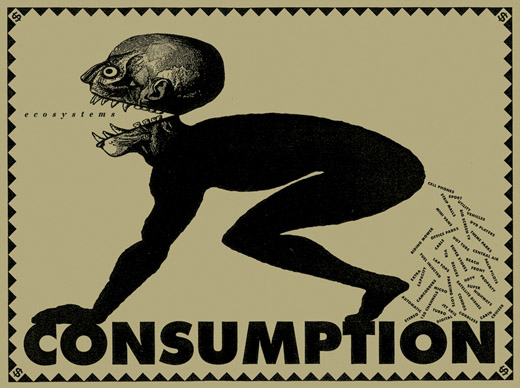
According to Kierkegaard, most people in modernity merely reflect the norms and attitudes of the social world into which they happen to be thrown. In the modern age, individual feelings of self-worth and personal identity are based upon the socially accepted criteria of comparative worth. One distinctive modern day dilemma, the constant comparison with our neighbor’s material goods called ‘‘keeping up with the Joneses,’’ can be viewed as one example of leveling.

Looking at the Joneses is merely an expression of what our culture tells us we are supposed to have. When we don’t “have” what our culture determines what we are supposed to have the discourses become the discourses of lack. Rather than finding fulfillment, these discourses press upon us. “I should have…” “I want…” I need…” 

We find ourselves frustrated, incomplete, unsatisfied. We are looking not at inner growth, or inner strength, but outside of ourselves. Again we find lack.  Rather than questioning the concept of conspicuous consumption and the critically looking at the entire operation of these discourses imposed upon us by society, we turn inward and against ourselves. 

As Kierkegaard wrote, 

"The human being compares himself with others; the one generation compares itself with the other and thus the heaped-up pile of comparisons overwhelms a person. As the ingenuity and busyness increase, there comes to be more and more in each generation who slavishly work a whole lifetime far down in the low underground regions of comparison" (Kierkegaard, 1847/1993, p. 189)

What would Kierkegaard think? I’m not certain, but I think he’d be shocked that we spend so much time and effort and resources and money on things that don’t really matter. Remember the person who dies with the most toys is still – in the end – dead.


Sunday, October 2, 2011

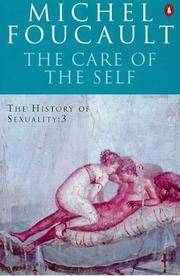
10 Philosophy Books 4 Your Perusal (Pt 8): The Care of the Self


Michelle Foucault


The History of Sexuality, Vol. 3: The Care of the Self 

Ethics. Identity. Selfhood. Self-Discipline. Discourse. That’s how you could sum up the latter part of Foucault’s project, if of course you could sum up Foucault's opus. However, like any good philosopher's works, you just can't sum it up. It is always being put to new and different uses. (Which reminds me of the old quote: "The history of philosophy is just one long footnote to Plato.")

Plus, reading Foucault can sometimes make your head do this.

Anyway, once interested in the genealogy of society, madness, and order, Foucault moved on to the development of the subject, a.k.a. the person, a.k.a. the human individual. It is in The History of Sexuality, Vol. 3: The Care of the Self that Foucault seriously delves into how discourses make us and how we use discourses to make our “selves.” 

Foucault contended that technologies of the self must be comprehended as inextricably connected to his notion of governmentality: the guiding rationales individuals and social structures use to regulate and police norms of thought and behavior. Foucault endeavored to show how the modern sovereign state and the modern autonomous individual co-determine each other’s emergence.

While Foucault was particularly interested in sexuality and the discourses surrounding sexuality and sexual identity his work has been influential in psychology, theology, gender studies, organizational communication. We will talk about some of those later. First, however, some of Michel.

“As a context, we must understand that there are four major types of these "technologies," each a matrix of practical reason: (1) technologies of production, which permit us to produce, transform, or manipulate things; (2) technologies of sign systems, which permit us to use signs, meanings, symbols, or signification; (3) technologies of power, which determine the conduct of individuals and submit them to certain ends or domination, an objectivizing of the subject; (4) technologies of the self, which permit individuals to effect by their own means or with the help of others a certain number of operations on their own bodies and souls, thoughts, conduct, and way of being, so as to transform I themselves in order to attain a certain state of happiness, purity, wisdom, perfection, or immortality.” (1988)

Foucault’s opus indicates the importance of, and interrelationships between, identity, power and knowledge. For Foucault power does not reside is a particular person or institution, but is engendered instead in discourses, practices, and procedures of everyday life and becomes apparent when it is exercised. Power is everywhere in social relations, and is exercised at all levels of an organization and society through various discourses and processes. Human beings are made subjects – or socially constructed – through various disciplinary discourses. The control of the self is a form of control through the discourses of power/knowledge.

As Foucault (1993) noted, in order to study power and the individual one must examine governmentality, the contact points of the “techniques of domination and techniques of the self” (p. 203). Governing people…is not a way to force people to do what the governor wants; it is always a versatile equilibrium, with complementarity and conflicts between techniques which assure coercion and processes through which the self is constructed or modified by himself (p. 203-204). Discipline therefore is not simply imposed from the outside, nor is it always complete, otherwise there would be no place for reflexivity. For Foucault, governmentality is not negative, but productive. It socially constructs subjects, reality, objects and rituals of truth.

While subjects are constructed through discursive processes, they are never powerless, but are active participants in creating the identities they desire by relying on various discourses. They can rebel and resist. (Remember Camus?) Individuals have the ability through these technologies of the self to reflect upon, shape, govern, and be responsible for their selves within these discourses and resources of power, to transfigure themselves to achieve a condition “of happiness, purity, wisdom, perfection, or immortality."

I am an organizational communication scholar and I've been heartily influenced by Foucault. Given the dynamic complexity of interrelated power relations, organizational scholars turned to the concept of struggle, an ongoing, interactive, unpredictable, definition-creating activity that moves beyond the static power/resistance model of domination. Similarly, because power resides in networks of relationships, subjects freely call upon differing discourses in order to enact strategic games, and therefore, play games of identity. In organizations these issues of identity transcend personal, organizational and occupational lines. 

Here are some of my favorite Foucault works and those who have made use of Foucault: 


Michel Foucault's "History of Madness" in English, is the complete version of the English translation called "Madness and Civilization", which since it was abridged, produced some serious misinterpretations. Foucault shows how the idea of "madness" from the Middle Ages through the Renaissance and the Enlightenment to the present, has undergone several transformations of meaning.  It is excellent...

....and it might make your head do this.