Showing posts with label capitalism. Show all posts

Thursday, March 8, 2012

Counter-Narrative: An Important, Much Needed Book


Bud Goodall starts out with this truth: 

We on the left suck at narratives. 

We do – at least compared to the right - be that right the economic libertarians, the religious conservatives, the neo-cons, or the conspiracy theorists like the Birthers.  Slowly but surely those on the right have spun their tales so well, that what they say is too often taken for granted, as given, as the way things are and the way things ought to be. All these ‘givens’ aren’t givens at all. They are stories told over and over and over until we believe them to be true. For instance:

“Free markets should be unfettered!” (Hello financial crisis.)
“Democrats are weak on defense!” (Goodbye Osama Bin Laden!)
“Jesus was not interested in justice!” (Hello? Have you read the New Testament?)
“Obama is a Kenyan born Muslim!” (Hello long-form birth certificate!)
“Rush Limbaugh is a Big Fat Idiot!” (Yes, ridicule is helpful but not constructive in the long term.)

Sure, we have facts on our side.
Yes, the deficit was caused by the Bush tax cuts and the wars.
Yes, Jesus was interested in justice.
Yes, the founding fathers were human with human foibles.
Yes, Teabaggers gave themselves that name without knowing what “Teabagging” is.

Here’s the thing: facts only matter if they are embedded in a good story. To quote Reagan’s 1988 slip up: “Facts are stupid things.” Narratives drive information, not the other way around.

Have you ever wondered how Al Queda can recruit people into killing themselves? Have you ever wondered why Glenn Beck’s conspiracies were accepted by so many? Have you ever wondered why the Birther issue will not die? Have you ever wondered why people who say they follow Jesus only follow the free-market Jesus? Have you ever wondered why academics are losing the battle over who academics are and what we do? Have you ever wondered what ever happened to the concept of the common good (clean air and water, state and national forests, public education, etc.)? Here you will find the stories conservatives tell dismantled, examined, and critiqued.

Finally Goodall doesn’t let us off the hook. He delivers to us an ultimatum.  If we don’t start actively writing our narratives to counter the conservative narratives, we will no longer have the words by which to tell our narrative.

Read it. Practice it.

Sunday, January 29, 2012

An Open Letter to President Obama from Someone "On Notice"

Dear Mr. President,

In your last State of the Union you put public higher education “on notice,” if we do not to try to keep costs down. I’ve been in academe for over 10 years both in information technology and more recently as faculty. Let me give you a little advice. Universities are raising tuition for two basic reasons: cuts in public funding and cuts in student aid. Not loans. Aid.

Universities now receive less funding from state government and more financial patronage from industry. Over the last thirty years, states have cut their budgets for postsecondary education by a national average of 34 percent. At the same time, vocational training in universities increased due to pressure from both students – who want to graduate and attain employment – and industries that need students to have certain skills. Institutions of higher education began engaging in market-like behaviors, a kind of “academic capitalism” in which educational outcomes (students and artifacts of research) are “products.” In the past twenty years, university autonomy has shrunk under the pressure of government, industry and student demands for accountability. Academia is becoming managed. We are doing more with less. This has led to some interesting consequences.

For example, as of 2003 only 44.9 percent of all faculty members hold full-time tenured positions. Schuster & Finkelstein conclude “contingent or term appointments became during the past decade the modal form of new full-time faculty appointments” (p. 55). In addition, from 1993 to the present, the percentage of all newly hired full-time faculty appointed to non-tenure track positions increased every year from barely more than 50 percent to almost three in five. Looking through a wider lens, in the last thirty years the categories of full- and part-time non-tenure-track faculty—both increased by over 200 percent. Just as in other areas of the economy, more and more faculty members are “outsourcers.” Outsourcers are contingent, non-traditional, term contracted employees, who are solely responsible for their career development and receive little, if any, organizational support, benefits, or recognition.

So in reality Mr. President we have been cutting back for years by hiring part-timers over tenure track faculty members. Guess what? It still doesn’t make up for all the cuts in government funding. It’s time to stop treating a higher education as a commodity and like a public good again.

Mr. President, your threat to put us “on notice” is redundant. We’ve been on notice for twenty years.

Sincerely,

Dr. Andrew F. Herrmann

Thursday, December 22, 2011

What Soren Kierkegard Might Think of Americans


In his book Two Ages, which is superficially a review of a Thomasine Gyllembourg novel with the same name, Kierkegaard examines the political and social dissimilarities between the Romantic period and the modern period. 

‘The present age is essentially reasoning, reflective, passionless, fickly flaring up in enthusiasm and shrewdly resting in indolence’’ (Kierkegaard, 1846/1978, p. 64).

In particular, Kierkegaard critiques such communicative activities as chatter, everyday talk, the press, and the commodification of discourse. Each of these activities is involved in the process Kierkegaard calls leveling. Kierkegaard presents an understanding of how communication activities can create—and individuals can put on—a culturally accepted, but objective, socially constructed definition of self. According to Kierkegaard, this process of leveling leads to objectivity and personal irresponsibility.

Leveling takes individuals out of themselves and makes them part of the public, which for Kierkegaard is an abstraction. Through the continual comparison of selves to others, we create and develop secondhand needs, desires, and definitions of selfhood—of who and what we are to be (Kierkegaard, 1847/1993). 

‘‘The trend today is in the direction of mathematical equality, so that in all classes about so-and-so many uniformly make one individual’’ (Kierkegaard, 1846/1978, p. 85). 

Kierkegaard is charging that unreflective communicative processes create a homogeneous abstraction—the public—where all socialized persons become interchangeable and where no one lives as an individual. Thus, one becomes a mere representation of a type, or a follower of an ideology, a part of the crowd.

Through leveling, the individual accepts society’s monological definitions of one’s self. Kierkegaard claims that rather than enabling people to take personal responsibility for their lives, the modern way of life makes it difficult to be anything other than conformists. The individual: 

‘‘forgets himself, forgets his name (in the divine understanding of it), does not dare to believe in himself, finds it too venture- some a thing to be himself, far easier and safer to be like the others, to become an imitation, a number in a crowd’’ (Kierkegaard, 1849/1980, pp. 166–167). 

According to Kierkegaard, most people in modernity merely reflect the norms and attitudes of the social world into which they happen to be thrown. In the modern age, individual feelings of self-worth and personal identity are based upon the socially accepted criteria of comparative worth. One distinctive modern day dilemma, the constant comparison with our neighbor’s material goods called ‘‘keeping up with the Joneses,’’ can be viewed as one example of leveling.

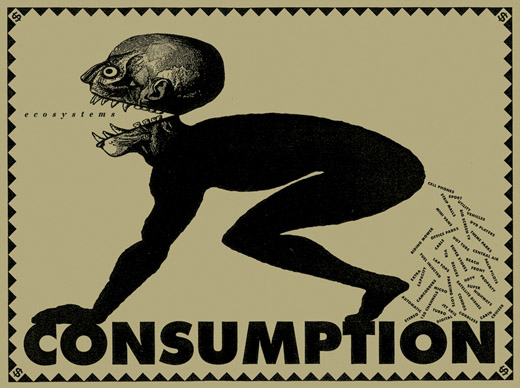
Looking at the Joneses is merely an expression of what our culture tells us we are supposed to have. When we don’t “have” what our culture determines what we are supposed to have the discourses become the discourses of lack. Rather than finding fulfillment, these discourses press upon us. “I should have…” “I want…” I need…” 

We find ourselves frustrated, incomplete, unsatisfied. We are looking not at inner growth, or inner strength, but outside of ourselves. Again we find lack.  Rather than questioning the concept of conspicuous consumption and the critically looking at the entire operation of these discourses imposed upon us by society, we turn inward and against ourselves. 

As Kierkegaard wrote, 

"The human being compares himself with others; the one generation compares itself with the other and thus the heaped-up pile of comparisons overwhelms a person. As the ingenuity and busyness increase, there comes to be more and more in each generation who slavishly work a whole lifetime far down in the low underground regions of comparison" (Kierkegaard, 1847/1993, p. 189)

What would Kierkegaard think? I’m not certain, but I think he’d be shocked that we spend so much time and effort and resources and money on things that don’t really matter. Remember the person who dies with the most toys is still – in the end – dead.


Sunday, October 9, 2011

Your Bank Hates You: From Banks to Credit Unions


My First Experience with a Big Bank

What’s going on with the big banks today reminds me of what happened in the early 1990s. When I went to work for Leadership Directories, Inc. (Back then it was called Monitor Publishing, but eventually changed its name because Monitor is the name of the paper the Christian Scientists publish – which we had nothing to do with)… oh that was a heck of a digression.

Anywho, when I went to work in NYC in 1991, I opened an account at Manufacturer’s Hanover. “Manny Hanny” was a pretty big bank, but it was regional to New York City. Plus, being based in NYC as it was, I could get money out of a MAC anywhere in the city. 

For those who don’t know MAC stands for “Money Access Center,” the old northeast version of ATM. By the way, never call an ATM an “ATM Machine.” ATM stands for Automated Teller Machine, so if you say ATM Machine you are really saying Automated Teller Machine Machine. And that’s idiodic. Like saying PDF File. PDF stands for Portable Document File, so really you are saying Portable Document File File. You are using an RAS. Please stop. Try not to sound like a mentally-challenged platypus. But again, I digress…

So I could get money once I got to the city via the PATH train, or on the way home via a MAC machine. (“MAC machine” is, by the way, allowable since there is no redundancy.) Checking was free as long as there was a direct deposit from my place of work. Not a problem at all and I had that Manny Hanny account for about a year. I actually used to walk through this door to do my banking.


The Manny Hanny Golden Door on 34th St.


Then they merged with Chemical bank. Chemical was having trouble with bad real estate loans (sound familiar?) and Manny Hanny was having problems with international loans (Argentina and Mexico, in particular), so they decided to join forces. At the time it was the largest bank merger in American History.

At first it was no big deal. Until Chemical – as the new bank was called – decided to close 70 locations. That put a damper on where I could get money, when I could get money, and how I could get money. No big deal, just a little bit more planning and walking and waiting in lines. Until…

Chemical decided that they did not want to deal with piss ants like myself. They decided to up the amount you had to have in your account to about $1,500 or they were going to start charging. People who were living paycheck to paycheck, people just starting out, or just starting over, or just making ends meet…people like my friends and I, didn’t have that money just laying in a bank. And they wanted rid of us. We were a PITA to them. They didn’t make any money off our piddly little checking account balances. We cost them money, so they put up barriers that basically forced us all to move. I went to Pamrapo Savings & Loan in Hoboken. Right across from the PATH, so again easy to get money going in or out of the city. My friends also changed banks. 


My 2nd Experience with a Big Bank


Eventually, however, I found my way back to a big bank. The big bank: Bank of America. I was fairly happy with them. Until... first they wanted to charge me $40 just to have one of their credit cards. Say what? A $40 fee on a $2K card. Please. Then they started to take away the free checking. That was that. Buh-bye.

Does this sound familiar? It should.  Bank of America is jacking up debit card rates and Citi is changing all sorts of requirements for depositors. Its not just the nationals. Regions, First Tennessee, and Suntrust all jerking around their customers with fees. It appears that the banks have decided that we aren’t worth it. They don’t want to deal with the “loser” working class anymore. Fine. Or they want us to move to credit cards so they can make even more money off of us. Fine. Piss on them.

Take your money out. Find a credit union. You can start here. And here. And here too. Forget the big banks. We bailed them out. They took our money. Now they are using the money that we saved them with to charge us to use our own money. Eastman Credit Union is my new financial institution.


And the colonists thought King George was a nonrepresentative taxer! If Thomas Paine and Sam Adams, etc. could see what was going on now, they’d be right in the thick of #occupywallstreet, in their white powdered wigs, getting ready to burn down some buildings and start another revolution!

What ever happened to my old Manny Hanny? Chemical....


was bought by Chase...


...which merged with JPMorgan...
...and is now JPMorganChase. 


JPMorganChase is one of the biggest banks in the world, like BoA, Wells Fargo, and Citi. We bailed them all out. They are all  charging people to use their own money. Leave them. They don't love you. In fact, they are abusive, not only to you as a customer, but to our country as well. Leave them. GTFO.

Wednesday, February 2, 2011

10 Philosophy Books For Your Perusal (Part 1)

I’m going to give everyone my list of 10 books of philosophy that have really enlightened my thinking about life and how to live it. Granted these blurbs aren’t supposed to be full summaries, but will hopefully prod everyone into questioning some of the things about ourselves and in society that go unquestioned.  I've included links on the titles to free versions of the texts, when possible. Enjoy.

Number One:


“In general, if any branch of trade, or any division of labour, be advantageous to the public, the freer and more general the competition, it will always be the more so.”


Economists quote him. Business students read him. People from Milton Friedman to Karl Marx, to Ronald Reagan have used him. Yet, Adam Smith is best known for only half his philosophy. So, first on the list, believe it or not, is that paragon of economics, Adam Smith. Smith is much maligned and worshipped. Both attitudes are born of a severe ignorance by both his enthusiasts and critics. The reason? There is a complete lack of knowledge of Smith’s moral philosophy. The Wealth of Nations didn't come out of the blue. To truly understand Smith's economic masterpiece one must understand its moral foundation. Without Smith's essential prequel the famous (or infamous) Wealth of Nations is easily misconstrued, perverted, or disallowed.

It is not the love of our neighbour, it is not the love of mankind, which upon many occasions prompts us to the practice of those divine virtues. It is a stronger love, a more powerful affection, which generally takes place upon such occasions; the love of what is honourable and noble, of the grandeur, and dignity, and superiority of our own characters.

Borrowing the idea from Hutcheson, Smith appropriately deposits the premise of his economics in a seedbed of moral philosophy -- the rights and wrongs, the whys and why-nots of human behavior and relationships. He demonstrates our moral ideas and actions are a product of our nature as social creatures. It argues that sociology, psychology, and communication are better guides to moral action than straightforward reason. It identifies the basic sentiments of empathy, prudence, and justice needed for society to survive, and explains the additional beneficent, actions that enable it to flourish. Concern for one’s own interest and concern for the public interest - the common good - are inseparable. Benevolence is essential and to the advantage of the individual. That is not what we hear about today.

Smith's capitalism is far from a heartless, cruel, greed-motivated, love-of-profits-at-any-cost approach to the marketplace, when seen in the context of his moral philosophy. The Theory of Moral Sentiments corrects the impression that Smith was a laissez-faire capitalist. In fact, his moral philosophy a priori critiques the objectivist, self-interested capitalism of Ayn Rand. In fact, although Smith was in theory against regulations and government interference in the marketplace, he was NOT blind to the fact that unadulterated self-interest needed to be regulated when undue burdens and unfair practices abound. 

Smith was, in fact, very critical of businessmen. Indeed, the viewpoints expressed in Moral Sentiments make it clear that the popular conception of Smith as first and foremost a money-making, capitalistic economist concerned with wealth does not mesh well with his own philosophy.